
What does it mean to document an exchange rate?
It means keeping enough context to explain the rate later: the business record, the official source, the selected date, the rate used, and the evidence that ties those facts together.
The official institution remains the source of the reference-rate data. FXProof provides the signed, source-attributed proof and verification workflow around it.
What should the evidence contain?
Keep the signed proof with the accounting entry, close file, audit workpaper, tax schedule, invoice, declaration, expense record, or other business file that used the rate.
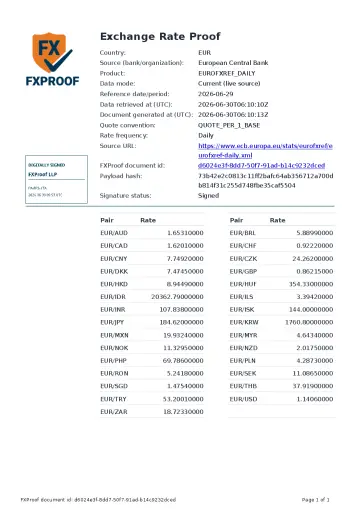
- Official source attribution and source date.
- Rate context for the selected dataset and date.
- FXProof document id, payload hash, and verification information.
- An embedded digital signature that can reveal changes to the signed PDF.
- A public check path for the document id and payload hash.
Why is the rate alone not enough?
A copied number does not show where it came from, which date was selected, or whether the same evidence can still be checked months later. A link or screenshot may help, but either can leave the reviewer rebuilding the context.
How does FXProof create the proof?
Choose a supported official source, dataset, and date. When the proof bundle is ready, FXProof packages the selected source data and verification details into a signed proof you can keep with the record.
The document is an FXProof proof, not a certificate issued by the source institution.
What can another person verify?
A recipient can inspect the source and rate context, validate the embedded digital signature, and use the document id and payload hash shown in the PDF on the public check page. The recipient does not need access to your account.
When do you need a bank record instead?
Use a bank statement, card record, or payment-provider record when the question is which rate was actually charged in a transaction. FXProof documents supported official reference rates; it does not prove a bank conversion or fee.
See a proof example
Open a public sample before you choose a plan. You can see how the source, date, rate context, document id, payload hash, signature, and verification details appear in the document.
Proof for a specific date
See how past-date availability and nearby ready dates work before you rely on a historical proof bundle.
Read historical proof guideProof from a supported source
Choose the institution expected by your policy, accountant, client, or reviewer, then open its source-specific proof page.
View supported sourcesWhat the signed PDF contains
Review the self-contained proof fields, digital signature, and public verification information.
Read signed PDF guideHow verification works
See what a recipient can check without access to your FXProof account.
Read verification guideWhen records disagree
If invoice, payment, bank, VAT, or ledger values differ, separate the source and date question before opening proof.
Open reconciliation use caseWhen software hides the source
Compare the accounting-system value with a chosen official source without claiming to know the software vendor's internal logic.
Read software source guideQuestions
Where can I get proof of an exchange rate?
Choose a supported source, dataset, and date. When the proof bundle is ready, FXProof provides a signed proof PDF that you can attach to the record that used the rate.
What document can I use as proof of an exchange rate?
Use the Signed FXProof Proof PDF. It keeps the source and rate context, document id, payload hash, digital signature, and verification information in one file.
Is an FXProof PDF an official exchange-rate certificate?
No. Official institutions publish the underlying reference-rate data. FXProof issues its own signed, source-attributed proof document and does not claim that it was issued by the institution.
Is a screenshot enough to prove an exchange rate?
A screenshot may provide source context. A signed FXProof proof PDF adds a consistent record and verification path. The recipient, procedure, and jurisdiction determine what evidence is accepted.