Available proof datasets
HMRC Average Exchange Rates
Early (Yearly)
hmrc|hmrc_average|early
HMRC Monthly Customs Exchange Rates
Monthly
hmrc|hmrc_monthly|monthly
HMRC Spot Exchange Rates
Early (Yearly)
hmrc|hmrc_spot|early
Who publishes this rate?
The institution publishes the reference rate. FXProof packages the selected source data and verification details into a signed proof.
FXProof is not affiliated with or endorsed by His Majesty's Revenue and Customs.
How do I keep HMRC proof with a VAT, customs, or invoice file?
Start with the supported HMRC dataset and the date or period applied in the file. FXProof can provide the signed PDF after that concrete proof bundle is ready.
Use the HMRC page when the file already identifies the HMRC dataset or period and the preparer needs one checkable record beside the schedule, declaration, invoice, or client workpaper.
Does the signed proof PDF come from HMRC?
No. HMRC publishes the underlying exchange-rate data. FXProof creates and signs its own proof PDF; it is not an HMRC-issued document, and FXProof is not affiliated with or endorsed by HMRC.
- His Majesty's Revenue and Customs source attribution.
- Source date or reference date used for the rate.
- Rate context for the selected dataset and date.
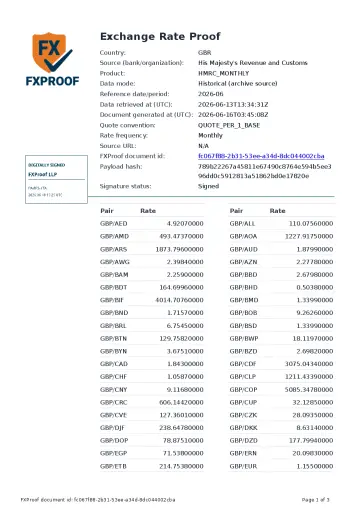
- FXProof document id, payload hash, digital signature, and verification information.
What does the FXProof PDF add to an HMRC printout?
A saved HMRC page can show where the data came from. The FXProof PDF keeps the selected source, date or period, and rate context together with its digital signature, document id, payload hash, and verification details.
Attach the PDF to the tax, customs, accounting, or client record that used the rate. The applicable rules and the recipient's evidence requirements remain outside FXProof.
Inspect an HMRC proof sample
See how HMRC attribution, selected period context, document id, payload hash, and verification details appear in the signed PDF.
View a proof sampleHMRC monthly record workflow
Keep the period, filing context, and signed proof together when a customs, VAT, tax, or accounting file uses HMRC monthly rates.
Open HMRC monthly guideCustoms and VAT file
Use this when the declaration, VAT file, or import calculation needs source/date evidence and a separate filing explanation.
Open customs and VAT use caseTax workpaper
Keep HMRC source/date proof beside the tax schedule without turning the proof into tax advice.
Open tax use caseBank or official rate?
Check whether the file asks for the actual transaction rate or an official reference rate before attaching evidence.
Compare bank and official ratesQuestions
Can I request HMRC exchange-rate proof for an earlier period?
You can check the supported HMRC dataset and period. The signed proof PDF is available only when the matching proof bundle is ready.
Is the PDF an HMRC-issued certificate?
No. It is a signed FXProof proof document that attributes the underlying rate data to HMRC. It is not issued or endorsed by HMRC.
Where should I keep the HMRC proof PDF?
Keep it with the tax schedule, customs file, accounting record, or client workpaper that used the rate. The FXProof proof and verification fields remain inside the PDF.
What can a tax or customs reviewer inspect?
The reviewer can inspect the source and rate context, validate the PDF signature, and check the document id and payload hash through the public FXProof page.