What is a bank exchange rate?
Use the bank, card, or payment-provider record when you need to show what was actually charged, converted, or settled. The statement or transaction record should remain the evidence for that conversion.
- A card purchase converted by the card issuer.
- A bank transfer settled at the bank's customer rate.
- A payment-provider payout with its own conversion fee and rate.
What is an official reference rate?
An accounting policy, tax rule, customs procedure, contract, or internal method may call for a published reference rate instead of the rate used by a bank. In that case, keep the official source, selected date, and rate context with the calculation.
- An accounting entry translated under a stated policy.
- A tax or VAT calculation that refers to an official source.
- A customs file that uses a prescribed reference rate.
- An internal review that needs one consistent benchmark.
Which one belongs with an invoice, expense, or accounting record?
Keep the bank or payment-provider record when the question is what happened in the transaction. Keep official-rate evidence when the calculation follows an accounting policy, tax rule, customs procedure, contract, or other method that names a public reference source.
For an invoice or expense, you may need both: the transaction record for the amount actually charged and an official reference-rate proof for a separate accounting, tax, or review calculation.
When is a bank statement the right evidence?
Use the bank statement, card record, or payment-provider record when you need to show the amount settled, the conversion applied to a transaction, or the fee charged. FXProof does not recreate or certify that transaction.
What does an FXProof document establish?
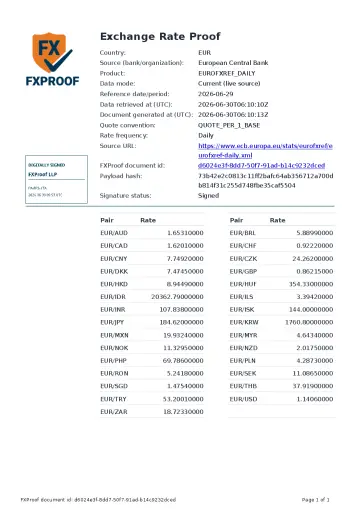
FXProof packages a supported official source, selected date, rate context, document id, payload hash, digital signature, and verification details into a signed proof. It does not replace the transaction statement and does not decide which rate your rule, adviser, or recipient requires.
What should you keep with the calculation?
Keep the invoice, expense, accounting entry, tax file, customs calculation, or review record, together with the reason for choosing the rate. Add the bank record, official-rate proof, or both according to the question the file must answer.
Need an official reference rate?
Open an example and see how the selected source, date, rate context, and verification details appear together.
See an official-rate proof exampleNeed to support an expense?
See how the transaction record and exchange-rate evidence play different roles in an expense file.
Open expense use caseReconciling different rates?
Separate source, date, direction, precision, and transaction-rate questions before choosing which evidence belongs in the file.
Open reconciliation use caseCustoms or VAT file?
Use official-source evidence only when the procedure calls for it, and keep the filing context outside the proof.
Open customs and VAT use caseQuestions
Can FXProof prove the rate my bank used?
No. Use the bank, card, or payment-provider record to prove the rate applied to a transaction. FXProof documents supported official reference rates.
Why can the bank rate and official rate differ?
They serve different purposes. A bank rate can include its pricing, timing, spread, or fees. An official reference rate is a published benchmark.
Which rate should I use for accounting or tax?
Follow the rule, policy, adviser, or recipient that governs the record. FXProof can document a supported official reference rate after you have made that choice.